Quick Facts
- Target Listings: SB Energy (Subsidiary) and Roze (Robotics Spinout)
- Projected Valuations: Over $50 billion for SB Energy; approximately $100 billion for Roze
- Core Technological Edge: Behind-the-meter solar integration and autonomous site construction
- Primary Partner: Strategic power supplier for OpenAI's 1.2GW Texas data center campus
- Market Context: SoftBank Group became Japan's most valuable company in June 2026 with a $306 billion market cap
- Investment Timeline: IPO windows projected to open in September 2026
Investors seeking an ai infrastructure company to invest in are looking beyond chipmakers toward physical buildout firms. SoftBank's 2026 IPOs of SB Energy and Roze robotics represent this shift, focusing on utility-scale renewable energy and autonomous construction to solve the primary bottlenecks of AI scaling.
| Company | Target Valuation | Core Business | Strategic Moat |
|---|---|---|---|
| SB Energy | $50B+ | Renewable energy & battery storage | Behind-the-meter power for AI campuses |
| Roze | $100B | Autonomous AI robotics | Rapid, labor-free data center construction |
| Crusoe AI | $40B | Clean computing & power | 45GW energy pipeline for stranded gas |
The Grid Bottleneck: Why Physical Assets are Peaking in 2026
The narrative surrounding artificial intelligence has shifted dramatically. In 2023 and 2024, the focus was almost entirely on the digital brain—the large language models and the GPUs that trained them. However, by mid-2026, the market has realized that you cannot run a digital revolution on an analog power grid. We have reached a point where energy-intensive computing is the dominant driver of industrial demand, and the largest ai infrastructure companies are no longer just software firms; they are the companies that own the power and the land.
The primary barrier to AI growth today is not a lack of chips, but the grid interconnection queues. In many jurisdictions, a new data center can take five to seven years just to get connected to the electrical grid. This delay creates a massive premium for any ai infrastructure company that can bypass the public utility system. Investors are currently rotating their portfolios, choosing AI infrastructure stocks beyond chips to find value in the firms that can actually build and power these facilities.
SoftBank Group’s recent rise reflects this reality. In June 2026, SoftBank Group’s market capitalization reached approximately $306 billion, surpassing Toyota as Japan's most valuable company. This valuation is grounded in Masayoshi Son’s pivot from speculative software to the heavy AI layer: the physical infrastructure buildout required to support a world of trillion-parameter models.
SB Energy: Scaling the Power Layer with OpenAI
At the heart of SoftBank’s infrastructure play is SB Energy. As the market prepares for its upcoming listing, the target valuation of over $50 billion is driven by its unique approach to utility-scale battery storage and renewable energy integration. Unlike traditional energy companies, SB Energy is specifically designed to function as the lifeblood of massive AI campuses.
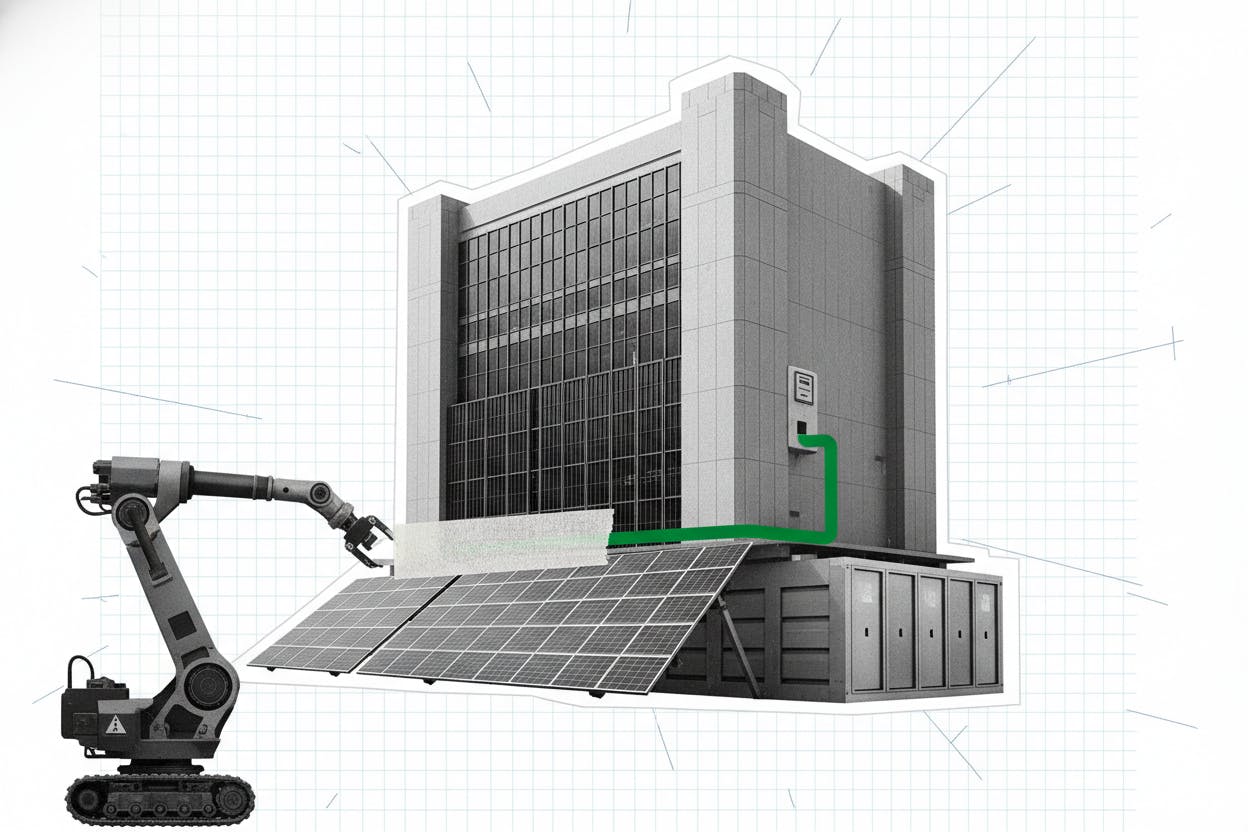
The company's crown jewel is the 1.2GW Texas data center campus project, developed in partnership with OpenAI. This project utilizes behind-the-meter generation, a technical strategy where power is generated and consumed on-site rather than being pulled from the public grid.
- Sustainable Data Centers: SB Energy integrates vast solar arrays with high-capacity utility-scale battery storage to provide 24/7 carbon-neutral power.
- OpenAI Partnership: The Texas campus is designed to house the next generation of "Stargate" class supercomputers, making SB Energy a critical partner in the OpenAI ecosystem.
- Regulatory Bypass: By generating its own power, SB Energy avoids the years-long wait times typical of regional grid interconnection queues.
For those looking for an ai infrastructure company to invest in, SB Energy offers a direct play on the decarbonization of AI. It addresses the "power scarcity" that has stalled competitors, providing a concrete solution for the data center power supply crisis of 2026.
Roze Robotics: Accelerating AI Infrastructure Construction
If SB Energy provides the power, Roze provides the speed. One of the most anticipated capital market listings of the year is the approximately $100 billion IPO of Roze, SoftBank’s AI robotics spinout. Roze focuses on the physical infrastructure buildout using industrial automation robotics to build data centers autonomously.
The logic is simple: there aren't enough specialized construction workers to build the $500 billion worth of planned AI factories. Roze robotics for autonomous AI infrastructure construction solves this labor shortage by deploying fleets of robots that can grade land, install server racks, and connect cooling systems with minimal human intervention.
"The bottleneck for AI is no longer the speed of the code, but the speed of the concrete," notes a recent strategy report. "Roze is essentially building the factories that build the intelligence."
This spinout represents a significant evolution in industrial automation. By using the same AI logic that powers LLMs to control heavy machinery, Roze allows for a physical infrastructure buildout that is 40% faster and 30% cheaper than traditional construction methods. This makes Roze one of the top AI infrastructure picks for June 2026 for investors who prioritize the "picks and shovels" of the AI era.
Competitive Landscape: Crusoe AI vs. SoftBank's 'AI Factory'
While SoftBank holds a dominant position, it is not the only player in the field. Investors are also closely watching crusoe ai, which has recently seen its own valuation climb following a massive investment round. The crusoe ai valuation after latest funding round sits near $40 billion, driven by its 45GW power pipeline.
Unlike SB Energy, which focuses on solar and batteries, crusoe ai has built its reputation on capturing stranded energy—such as natural gas flaring—to power modular data centers. This makes them a strong rival in the race to provide an affordable data center power supply.
- SoftBank: Focuses on centralized, utility-scale campuses and integrated robotics construction.
- Crusoe AI: Focuses on distributed, environmentally conscious power sourcing and modularity.
- Cerebras: While not a power company, the Cerebras IPO remains a significant alternative for investors seeking hardware that is more energy-efficient than traditional GPUs.
When considering ai infrastructure companies to invest in 2026, the choice often comes down to the style of infrastructure. SoftBank is building the massive, permanent "AI Factories" of the future, while firms like Crusoe offer flexible, rapidly deployable solutions.
Investor Outlook: Harvesting the 2026 IPO Super-Cycle
The 2026 IPO market is dominated by the realization that AI is a physical industry. SoftBank’s commitment is not limited to North America; they have also announced a commitment to invest up to €75 billion to develop 5 gigawatts of AI data center capacity in France by 2031. This represents their largest infrastructure investment in Europe and underscores the global nature of this buildout.
For long-term investors, the risk-aware strategy is to look for companies that own "moated" physical assets—land, power permits, and proprietary construction tech. As the chip market matures and competition among hardware makers increases, the real value is migrating to the companies that facilitate energy-intensive computing.
SoftBank's upcoming listings of SB Energy and Roze represent the peak of this infrastructure cycle. They provide the necessary power and the means of construction for an industry that is currently hungry for both. Whether you are looking at utility-scale battery storage or autonomous robotics, these two IPOs are the definitive top AI infrastructure picks for June 2026.
FAQ
Who are the biggest AI infrastructure companies?
The largest players today include established cloud giants like Amazon, Microsoft, and Google, alongside hardware leaders like Nvidia. However, in 2026, the list has expanded to include physical infrastructure specialists such as SoftBank Group, crusoe ai, and specialized hardware firms like Cerebras.
What are the best AI infrastructure companies to invest in?
While Nvidia remains a core holding for many, the best opportunities in 2026 are found in the physical layers. Companies like SB Energy (focusing on power) and Roze (focusing on construction) are highly regarded, as are firms managing renewable energy integration for data centers.
Who builds infrastructure for AI?
The construction of AI infrastructure is a collaboration between traditional real estate developers, cloud providers, and new autonomous construction firms. Hard-asset companies like SoftBank are increasingly taking the lead by using Roze robotics to automate the buildout of massive server campuses.
What are the three AI infrastructure stocks?
Three significant stocks to watch in the current market are SoftBank Group (for its energy and robotics subsidiaries), Microsoft (for its massive "Stargate" project investment), and Crusoe AI (following its transition toward large-scale clean power computing).
What company is building the AI infrastructure?
SoftBank is currently the most aggressive company building the physical backbone of AI. Through its SB Energy unit and Roze robotics spinout, it is handling everything from the renewable power supply in Texas to the autonomous construction of new facilities in France.