Quick Facts
- New Repo Rate: 6.75% (Effective June 18, 2026)
- Status Change: First monetary tightening after a three-year pause
- Prime Lending Rate: Increased to 10.25% across commercial banks
- Home Loan Base Rate: Adjusted to 11.25% for residential mortgages
- Inflation Trigger: Consumer Price Index reached 4.1% in May 2026
- Next Meeting: August 12, 2026, for the next Monetary Policy Committee review
On June 18, 2026, the Bank of Namibia raised the repo rate by 25 basis points to 6.75%. This decision ends a three-year pause and directly impacts Namibian bank lending rates. The new repo rate of 6.75% is a move by the Monetary Policy Committee to curb inflationary pressures, resulting in immediate increases to prime lending rates across all commercial banks, which now stand at 10.25%.
The Decision: Why the Repo Rate Rose to 6.75%
For the past three years, Namibian borrowers enjoyed a period of relative stability as the central bank held its benchmark interest rate steady. However, the shift from a neutral stance to one of moderate tightening was prompted by a significant uptick in the cost of living. The primary driver behind this shift was the realization that inflationary pressures were becoming more persistent than previously anticipated.
Data from the central bank indicates that the domestic inflation rose from 2.1% in March to 4.1% in May 2026. This sharp climb reflects the rising costs of essential commodities, particularly oil and fuel, which have a cascading effect on transportation and food prices. When the Consumer Price Index accelerates at this pace, the Bank of Namibia uses the repo rate as a tool to dampen demand and prevent inflation from spiraling out of control.
By adjusting the Bank of Namibia repo rate 2026 forecast upward to 4.0% for the full year, the central bank is signaling that the era of cheap credit is retreating. For the everyday borrower, the Bank of Namibia repo rate hike 2026 meaning is clear: the cost of holding debt has just gone up, and the purchasing power of your disposable income is under renewed pressure.
The Rand Connection: Why Namibia Mirrors South Africa
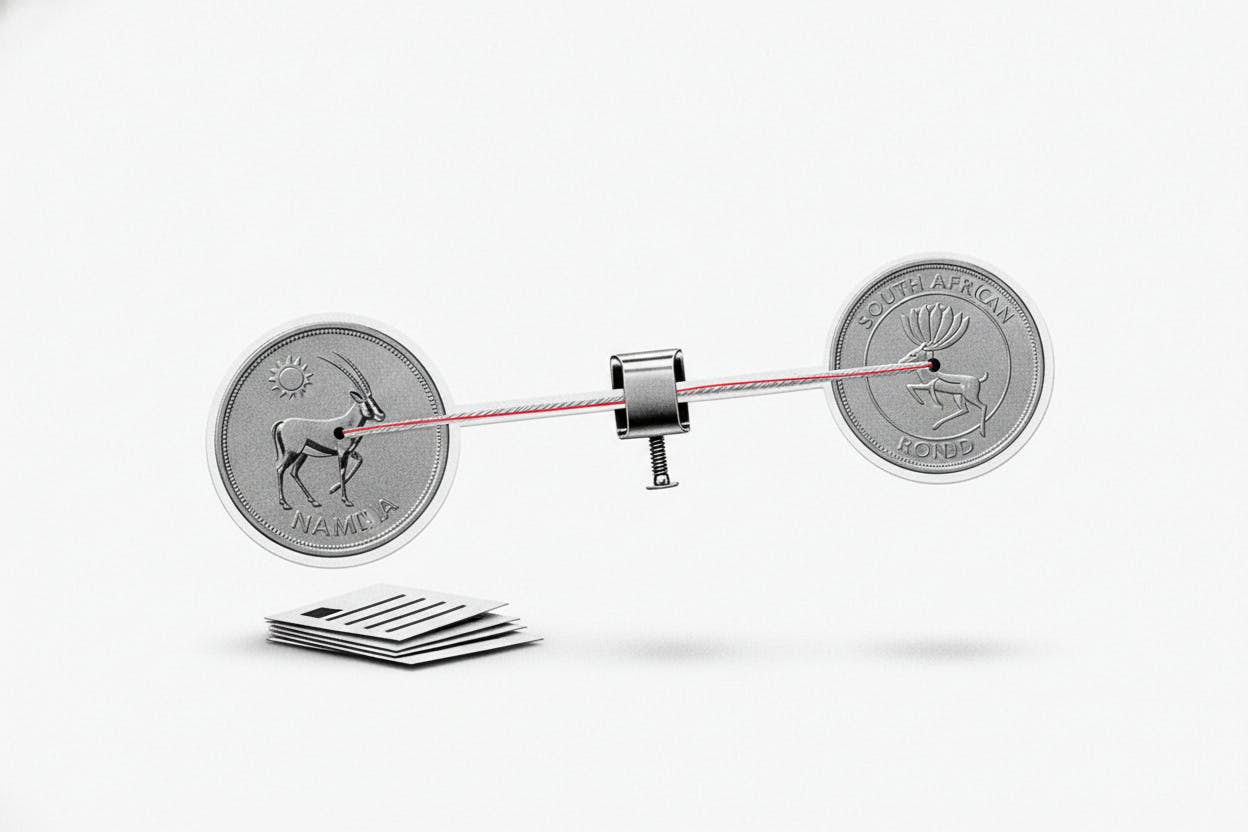
A unique feature of the Namibian economic landscape is the Namibia dollar rand peg impact. Because the Namibian Dollar is pegged one-to-one with the South African Rand, our monetary policy cannot exist in a vacuum. The Bank of Namibia must maintain a delicate balance to ensure that capital does not flow out of the country in search of higher returns in South Africa.
If the South African Reserve Bank raises its rates while Namibia remains stagnant, investors are likely to move their funds across the border. To maintain the currency peg and ensure financial stability within the Common Monetary Area, the Bank of Namibia often mirrors the actions of its neighbor.
Interestingly, while the namibia repo rate has moved to 6.75%, this remains 75 basis points lower than the current South African Reserve Bank repo rate. This spread allows for some domestic flexibility, yet the recent hike shows that the central bank felt it could no longer delay tightening. Even when domestic credit extension is sluggish, the structural requirement to protect the exchange rate often necessitates higher borrowing costs. As of June, the interest rate spread in Namibia has tightened to 3.50 percentage points above the repo rate, bringing the country into closer alignment with South Africa and Lesotho.
Commercial Impact: Prime Lending and Home Loan Rates
When the central bank moves the repo rate, commercial banks move in lockstep. The most immediate impact of the 6.75% repo rate is the adjustment of the prime lending rate, which serves as the benchmark for most private sector credit.
For homeowners, the impact of repo rate hike on home loans Namibia is significant. Most residential mortgages are variable rate credit, meaning your monthly installment changes as soon as the bank adjusts its base rate. Standard Bank Namibia, for instance, moved its home loan base rate from 11.00% to 11.25% immediately following the announcement.
| Rate Type | Previous Rate (May 2026) | New Rate (June 2026) | Increase |
|---|---|---|---|
| Bank of Namibia Repo Rate | 6.50% | 6.75% | +0.25% |
| Commercial Prime Lending Rate | 10.00% | 10.25% | +0.25% |
| Home Loan Base Rate | 11.00% | 11.25% | +0.25% |
| Usury Act Maximum (Credit Granting) | 16.15% | 16.40% | +0.25% |
The prime lending rate for commercial banks rose to 10.25%, which translates to higher debt servicing costs for any household or business with an existing loan. If you are paying off a N$1,000,000 mortgage over 20 years, a 0.25% increase might seem minor, but it adds hundreds of dollars to your monthly payment and thousands to the total interest paid over the life of the loan.
Sector-Specific Impacts: Vehicle Finance and Personal Loans
Beyond housing, the move to a 6.75% repo rate ripples through other forms of consumer credit. The effect of repo rate increase on vehicle finance Namibia is often felt within one billing cycle. Since most car loans are linked to the prime rate, the monthly installment on your vehicle will likely increase.
For families already struggling with the rising cost of living, this reduction in disposable income can be painful. The Usury Act maximum rate, which dictates the highest interest rate that can be charged on credit agreements, has also climbed to 16.40%. This affects personal loans and credit card facilities, making short-term borrowing an even more expensive prospect.
Business owners are also facing a squeeze. As Namibian bank lending rates rise, the cost of working capital increases. For small to medium enterprises (SMEs) that rely on overdraft facilities or short-term loans to manage cash flow, the 25 basis point hike represents a direct hit to the bottom line. This environment often leads to a slowdown in business expansion as firms become more cautious about taking on new debt.
Strategies for Borrowers: Managing Debt in 2026
As a personal finance editor, my advice is always focused on stability. We are entering a period where managing debt rising interest rates Namibia is a prerequisite for financial health. You cannot control the Bank of Namibia, but you can control your response to their decisions.
Here are actionable steps to handle the 6.75% environment:
- Review Your Budget: With the Standard Bank Namibia prime lending rate 2026 adjustment now in effect, sit down and calculate exactly how much your monthly debt obligations have increased.
- Prioritize High-Interest Debt: Focus on paying down credit card balances or personal loans that are closer to the Usury Act maximum of 16.40%.
- Inquire About Fixed Rates: If you are risk-averse, speak to your bank about the possibility of switching to a fixed interest rate. While these are often higher than variable rates initially, they provide certainty against future hikes.
- Make Extra Payments: If you have any surplus cash, even N$200 extra per month toward your home loan principal can significantly offset the impact of these rate increases over time.
- Avoid New Credit: Now is not the time to take on a new vehicle finance contract unless it is absolutely necessary. Focus on preserving your current credit score and maintaining liquidity.
If you are wondering how to lower monthly loan repayments Namibia, the most effective way is to negotiate with your lender based on a long-standing positive relationship or to consolidate higher-interest debts into your mortgage if you have sufficient equity. However, consolidation should be approached with caution as it places your home at greater risk.
Future Outlook: Forecasts Through 2028
The path forward for the namibia repo rate remains linked to both global commodity prices and regional monetary trends. While the current hike to 6.75% was a response to immediate inflationary pressures, many economists are watching the GDP growth projections closely. With a current projection of 2.6% growth for 2026, the central bank must be careful not to stifle the economy with excessive tightening.
Looking further ahead, some models suggest that the repo rate could stabilize or even face further upward pressure if inflation remains sticky. Trading Economics currently forecasts that interest rates in the region could trend toward 5.50% by 2028 in a best-case scenario of cooling inflation, but the 2026 landscape is clearly one of moderate tightening.
The Bank of Namibia's next move will be determined at the meeting on August 12, 2026. Until then, borrowers should plan for the current 6.75% rate to be the new baseline. Financial stability in this environment requires proactive planning and a lean approach to lifestyle expenses.
FAQ
What is the repo rate in Namibia?
The repo rate is the benchmark interest rate at which the Bank of Namibia lends money to commercial banks. It serves as the primary tool for controlling inflation and influencing the cost of credit throughout the economy.
What is the current repo rate today?
As of June 18, 2026, the repo rate in Namibia is 6.75%. This followed a 25 basis point increase by the central bank's Monetary Policy Committee to address rising inflation.
Who decides Namibia's repo rate?
The repo rate is determined by the Monetary Policy Committee (MPC) of the Bank of Namibia. They meet bi-monthly to review economic conditions, including inflation, GDP growth, and the status of the currency peg with the South African Rand.
What is FNB's current interest rate?
Following the central bank's hike, commercial banks like FNB Namibia typically adjust their prime lending rate to 10.25%. This rate applies to most variable-interest loans and serves as the starting point for calculating individual loan interest based on the borrower's risk profile.